Subscribe:

Ads 468x60px

Sunday, February 24, 2013

Way to deal with your boss: Treat your boss like a customer!


Director of Tata Sons, R Gopalakrishnan offers tips on leadership at work

Ramabadran Gopalakrishnan joined Tata SonsLtd, after working with Hindustan Unilever for three decades in various capacities, including as chairman of Unilever, Arabia, before he joined Tata Sons Limited as executive director in 1998. With 45 years of experience in all the rungs of management, R Gopalakrishnan authored his first book on vital lessons for subordinates and managers in 2007. His third book, What theCEO really wants from you:
Four straight As, was published last month. Mirror speaks to the author on important takeaways from his new book.

Excerpts of the interview:

What was the impetus to write the book?
I found that there were enough books on the habits, practices and behaviour of a great leader. But handling the journey towards becoming a great leader is an unmet need. Aspiring leaders cannot emulate the behaviour of those who have already assumed positions of leadership; else they would be misunderstood. That is what brought the book to my mind.

Image Source: The Hindu
Do you find a chasm between the expectation of the CEO and the capabilities of the managers/team leaders?
Yes, undoubtedly. When we are subordinates, we expect a lot more from our bosses and organisation than what we think we owe them. This creates an asymmetry of expectations. This asymmetry is at the heart of unhappiness and dissatisfaction.

How have the dynamics between the boss-subordinate changed over the years?
Everything in the world has changed, and so has this aspect. However, the boss-subordinate interaction is a relationship, not a defined object. That relationship is threatened by shorter attention spans and the advent of the digital economy. Relationships require time to nurture and blossom — whether it is boss-subordinate or family. There is data suggesting that people are changing jobs more than before. There is also data suggesting that divorce rates are higher than before and that more people seek happiness because they find it elusive. These examples elucidate and support my point.

The Tatas are known to be traditional workspaces. What are the challenges that the Group faces while hiring young talent, who may be used to work environments that are unlike the Tatas?
I do not think Tata faces any special challenges. Like many organisations, Tata too has developed its employment brand to meet the needs of new segments of employees. It is also satisfying that the Tata Group's attrition rates tend to be a tad lower than its peers. The Tata Group has always been strong in mentoring. There are stories of inspiration and mentoring that are legendary — how John Peterson mentored JRD Tata, for example. There are senior managers who acknowledge the mentoring influence of a Russi Mody or Sumant Moolgaonkar. Tata mentors quietly and effectively. Of course, there is always room for improvement.

In an increasingly globalised world, what are the challenges that professionals face to keep abreast of workplace dynamics?
Developing software to anticipate the needs of organisations and bosses and then setting out to meet those needs. This is much like how a marketing person would sense, serve and satisfy consumer needs. That is why I have argued in the book that a good subordinate should think of the boss as a sort of 'customer' without becoming supine or a yes-man.

Source: TOI

Friday, February 22, 2013

Phones And Smokes: 10 Creepy Similarities!!

Very good article i have found about the similarity between the cigarettes and mobile phones at Techtree.

We'd all agree that cell phones are addictive. Even most of us feel uncomfortable if out mobile phone is not with us for some longer time. But do you know that the similarities between these two objects of passionate desire are disturbingly broad-ranging.

1. AddictionPhones And Smokes: 10 Creepy Similarities
First up is the most obvious: Cigarettes and phones are both addictive. Here's a sober quote I found about this: "Cell phone dependency is now called compulsive communicating. Chain diallers call continually to get another fix." One statistic — for what it's worth — is from a survey commissioned by T-Mobile: "63% of smartphone users would climb through trash to find a lost phone." That's quite a bit like people on railway platforms looking for cigarette butts.

2. The Annoyance Factor

Smokers have long been a public nuisance, and for good reason: No-one likes smoke being blown in their faces. Cell phone users, on their part, have annoying ringtones, they talk loudly while ignoring others, and break the silence in movie theatres.


3. DistractionIt's all too familiar these days: A group of people are at a table, and every half minute, one person looks at his or her phone to check a message — and sometimes leaves the table. Smokers leave tables in pretty much the same way, though not as frequently — and usually in pairs or groups.


4. CarcinogenicityWe've read a little too much recently about the dangers of electromagnetic radiation, which we needn't repeat. But a month ago, the Italian Supreme Court ruled — not without controversy — that a man's brain tumour was directly connected to his cell phone usage. And we needn't mention the direct link between smoking and the dreaded C disease.


5. Brand LoyaltyNokia fan. Marlboro Man. Fandroid. "I only smoke Camels." We tend to attach some of our identity to our gadgets — and to the companies that make them. Much like smokers do with their brand.


6. Time WastingMost of us spend quite some useful time with our phones — and quite some useless time. The 10-a-day smoker spends about an hour and a half on his habit. In both cases, the user makes it look like he or she is doing something useful: If you stand and stare into space for five minutes at a stretch, you'll easily hear people talking in whispers about your mental state. But if you stare at a phone doing nothing particularly useful — or if you smoke a cigarette — you're OK.

7. Restricted AreasCell use and cigarette smoking are both banned in two interestingly diverse areas: Airplanes, and (in some areas) petrol pumps. The connection between petrol and radiation is not clear, but it was once a widespread idea that you could blow up a petrol pump by using a phone there. With cigarettes, that's a reality.
Also, the areas where smoking would be most obnoxious — theatres and plush restaurants — are also those where loud callers seem more obnoxious. And on planes, people pluck out their phones immediately upon landing — while the smokers pull out their similarly-sized cigarette packs.


8. Physical SchematicA phone needs an external actuating element (the charger); so does a cigarette (a lighter). A phone is divided into a top part (screen) and lower part (keypad); a cigarette has the white tobacco area and the brown filter area. If this connection seems far stretched, consider this: You can charge your phone using your car's cigarette-lighter adapter.


9. The "Running Out" PhenomenonWhen someone's battery is dying, the hunt for a charger and/or a charging point is pretty stiff. So is a smoker's hunt for cigarettes when he reaches the last couple in his pack. The element of panic is similar.


10. Taglines and the Lifestyle Element"Live life kingsize." "Life. (M)powered." "Connecting people." "Made for eafuch other." Which of these are phone company slogans and which are smokers' lines?
Of course, there is a long list of dissimilarities — for example, a cell phone serves a useful purpose, which cigarettes don't. But is there more to these parallels than just imagination? What's your take? (While you're at it, check out the cigarette box cell phone — but only if you're an incurable smoker.)

Read more details at TechTree

Know Why Failure is Necessary?


Nobody wants to fail in his/her life, but failure is inevitable. Virtually it’s impossible to be immune from failure, one day everyone has to face it in any arena of life. But failure isn’t that bad as we perceive and it’s just a phase of life. Failure teaches us many things which we wouldn’t have otherwise learned from just being successful, like:

  • Value of Time: Time is the most precious thing in this universe, unfortunately its true value is only known after tasting the failure. The more early the failure comes into our life, earlier we become more smart. If one always gets success then gradually he loses value of time and success, it becomes routine for him. He might even become complacent. Once a person has tasted failure he will realize the value of time and will thrive for success.


  • True FriendsWhen we are in good pace we have lots of friends who are there are for us all the time. But only failure shows us who our true friends are! Chanakya was right in quoting that its adversity which shows our true friends! Only those who are with us in our thick and thin are our true buddies.


  • Our True worth: We all formed some perception about self, which is naturally different from our real self. Either we are over confident about self or we underestimate self. A failure provides us opportunity to do a self assessment and SWOT (Strength, Weakness, Opportunity and Threats) analysis and we discover our real self or near real self. This is the moment when we discover the hidden talents in us and we actually realise who we really are!

Every human goes from success to failures and vice versa, and the cycle goes on. This is life and we must always keep hope and be humble when we are successful and be calm when we face failures in our life. And most important we must be compassionate with people who are struggling with their failure. Failure makes us a good person!

Secrets to a happy family

Your family bliss can be found in sweating it out with your kids, playing a goofy game of charades and Kyle Richards, a star of Bravo's reality TV series "Real Housewives of Beverly Hills," according to best-selling author Bruce Feiler.
Feiler turned to hundreds of examples of non-parenting wisdom from a variety of sources – from bankers to Green Berets – for his new book, "The Secrets of Happy Families," to bring families closer together, according to ABC News.
Some advice was quite surprising: try moving the furniture, ditch date night and let the kids pick their own punishments.
For advice on allowances, Feiler spoke with Warren Buffett's banker, who said not to tie allowances to chores. For games, he went to the folks at the online gaming giant Zynga, the makers of Farmville and other similar spinoffs, who told him that failure can be motivation to do better.
For conflict resolution, he went to the Harvard Negotiation Project and the set of ABC's TV series "Modern Family."
"All families have conflict. It's the families that cope with the conflict best that are the best able to function successfully. Laughter, silliness, games can be a great antidote to the conflict," Feiler said.
One can also take examples from Kyle Richards, the star of "Real Housewives of Beverly Hills," a show that thrives on screaming matches and backstabbing. She is the head of a tranquil family and she said her family life is "very real."
Raising daughters Farrah, Alexia, Sophia and Portia with her husband, Mauricio Umansky is her first priority and she takes the job seriously.
"Having four kids is not – especially as they get older – is not easy to get them, all four, at the same time to sit down to dinner. We have to fight for that all the time, but it's worth it," Richards said.
But those hard-fought moments create memories – a stitch in the tapestry of the larger family history, which is something Feiler also talks about in his book: The more your kids know about their family's legacy, the more resilient they are because it gives them a sense of pride in who they are and where they come from.
Feiler also said that successful institutions have mission statements and wacky family traditions can also breed happiness.
And to maximize team spirit among family members, Feiler said the Green Berets believe in pushing everyone's physical limits in pursuit of a common goal. ANI : Washington, Thu Feb 21 2013

Thursday, February 21, 2013

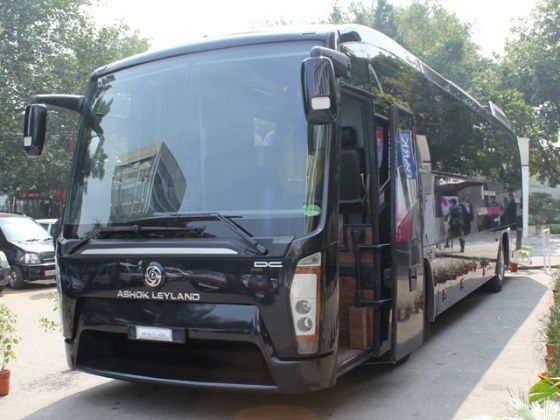
A Private Jet Based Bus Launched in India!


World's 4th largest bus maker Ashok Leyland have launched a Luxura Magical Bus in association with Toolfles Foundation at Park Hotel, New Delhi. Company claimed that it's going to be the unique concept being introduced in India. The bus has been developed under a joint-venture of Ashok Leyland, DC Designs, Toofles Foundation and Mann travels.The motive behind this project is to help the two charity partners Goonj NGO and Cancer Institute, Chennai. 

Ashok Leyland Luxura Magical India bus

The price of the bus has not been disclosed as this is a one-off vehicle. The charter rates have been pegged at Rs 30,000 for an 8 hour/80 km hire. For every kilometre after 80 kms have been covered, customers will be charged Rs 150 per kilometre and Rs 3,000 will be charged for every hour after the 8 hour charter time is exceeded. Mann Travels has also setup a charter for a day trip to Agra which is available on the Ashok Leyland Luxura Magical India bus for a sum of Rs 65,000. 


“Ashok Leyland is delighted to be a part of this project with its core values of innovation, focus on the customer front and delivery with a social conscience,” said Vinod Dasari, Managing Director, Ashok Leyland.
 

Monday, February 11, 2013

Study Says: Smartphone users check mobiles 150 times a day.


As Smart Phone user people are becoming more and more dependent on the technology. Such users checking their smart phone every six-and-half minutes, says recent survey.
During a waking day of 16 hours users check their smartphone for an average 150 times, study found.
Looking at their phone is the first thing many people do each day - as they use its alarm function - and is also the last, the study commissioned by a mobile phone brand found.
Image Source: hpmurah2u
In between, phones are used to check the internet and read emails, as well as to make calls and send texts, the 'Daily Mail' reported. 
Mobile technology consultant Tomi Ahonen who analysed the study, wrote on his blog that people make, receive or avoid 22 phone calls every day.
Image Source: www.techinasia.com
They also send or receive text messages 23 times a day, Ahonen said, and check the clock 18 times.
"The average phone user places three calls per day and also receives three calls," Ahonen said.
 "Where are the other 16 times? Interruptions! We have a dropped call (one per day) or we make a call attempt that won't go through (one per day)," he said.
Taking pictures, checking news, internet updates and plugging and unplugging the phone all added to the number of phone views, he said.

Wednesday, February 6, 2013

"Tata Nano" The Most Trusted Four- Wheeler Brand in India!


Yes, It's True!! Tata Nano has been officially declared as the most trusted four wheeler brand in India for the year 2013 by the ‘Brand Trust Report, India Study, 2013’. 


Trust Research Advisory who have conducted the study for India's Most Trusted Brands. In this study report they have declared 1100 Most Trusted Brands in 211 categories. The research was conducted among 2,505 influencer-respondents across 16 cities and generated nearly three million data points and 19,000 brands, making it the most intensive study on Brand Trust across the globe. 


From the very beginning  Tata Nano always generated a great excitement in the world auto industry with it's price tag of 1 Lakh INR as base dealer price. Starting from meeting all the Indian road safety tests for a four-wheeler, while being cost effective, to providing its customers with unmatched warranty of 4 years/ 60,000 km, Tata Nano has worked hard to win the trust of its customers.Tata Nano featured in the list of 2012’s ‘Top 10- Best Selling Cars’, re-enforcing the trust the brand holds in the Indian car buyer’s mind today. 


Tata Nano also boasts of a 3 million strong fan base on Facebook. It is the first automobile brand page in India to have this huge a fan base. Nano has been constantly interacting with its fans and customers and listening to their feedback to evolve its product and marketing strategies. Nano has launched some really unique concepts like Art In Motion and Nano Drive with MTV to appeal to its diverse owner and fan base. 


Tata Nano recently launched ‘Nano-Special Edition’ loaded with additional features like alloy wheels, glove boxes, music system and designer decals available at no additional cost making it the most desirable set of wheels on the road. With continued efforts in delivering more and more value to its customers, it appears, Tata Nano is committed towards increasing the trust it holds in the hearts of its patrons. In near future you may see more variants like CNG, Diesel and 800cc Petrol of this most trusted four wheeler of india.


Monday, February 4, 2013

Linux Desktop OS, Alternatives of Ubuntu!


Linux - A Free, Open Source and third most popular OS in the world. Linux is available in different flavors like Ubuntu, Fedora, RHEL, etc.. Among all Ubuntu is very famous as Desktop OS. Ubuntu is based on the debian OS. Here there are few OS distributions which can be considered along with ubuntu. 

Linux Mint


Linux Mint is merely one of many Ubuntu forks. Whether Mint is actually more popular than Ubuntu is up for debate, but the important part is that the Linux community has taken the Ubuntu code (you know, the Debian c0de) and customized it to add new features, serve a specific purpose in niche markets, and to offer up unique twists on user experiences.
So while Ubuntu is generally a good choice, it might not be exactly what you need. There are many other options out there that are worth knowing about.

BackBox Linux

Although BackTrack Linux is generally-considered the de facto distribution for penetration testing, BackBox has emerged as a promising Ubuntu alternative. The latest release is BackBox Linux 3 and it features an Ubuntu base with Linux kernel 3.2, a customized XFCE 4.8 desktop, and a number of computer forensics tools. The project began as a small project led by Raffaele Forte approximately three years ago.

PinguyOS

PinguyOS is a general-purpose operating system that is packed with features and ready-to-run with little-to-no user tweaking required. It focuses on a simple user interface that is friendly to new Linux users — especially those who are migrating from Windows or OS X computers.
The newest release is PinguyOS 12.04 Final, which (as the name suggests) is based on Ubuntu 12.04 LTS. On top of the Ubuntu OS, PinguyOS features a customized Gnome 3.4.1 desktop and a wide breadth of pre-installed applications.